


What is the export price of magnesium metal in China?
| Magnesium metal export price in China as of April 10, 2026 | ||||||
| variety | Specification | Export price (USD/ton) | Increase | Mainstream transaction volume (USD/ton) | Increase | Remark |
| Magnesium | Mg 99.9% | 2510-2530 | -- | 2510-2530 | -- | Tianjin FOB, no acid washing |
How to Choose the Right Grade of Magnesium Ingot
Choosing the right grade of magnesium ingot depends mainly on application requirements, purity level, alloy compatibility, and processing method. Industrial buyers typically select magnesium grades based on whether the end use is die-casting, aluminum alloy production, desulfurization in steelmaking, or chemical reduction processes. Higher purity magnesium is required for precision metallurgy and aerospace-related alloys, while standard industrial grades are sufficient for steel desulfurization and general alloying applications.
Magnesium Ingot Specifications (Industrial Grades)
| Grade | Mg Content (%) | Fe (%) | Si (%) | Ni (%) | Cu (%) | Al (%) | Application | Form |
|---|---|---|---|---|---|---|---|---|
| Industrial Grade Mg | ≥99.5 | ≤0.05 | ≤0.05 | ≤0.01 | ≤0.02 | ≤0.01 | Steel desulfurization | Ingot |
| High Purity Mg | ≥99.9 | ≤0.01 | ≤0.01 | ≤0.005 | ≤0.005 | ≤0.01 | Alloy production | Ingot |
| Ultra High Purity Mg | ≥99.95 | ≤0.005 | ≤0.005 | ≤0.002 | ≤0.002 | ≤0.005 | Aerospace / precision casting | Ingot |
| Alloy Grade Mg | 95–99 | Variable | Variable | Variable | Variable | Al/Zn/Ca added | Die casting | Ingot |
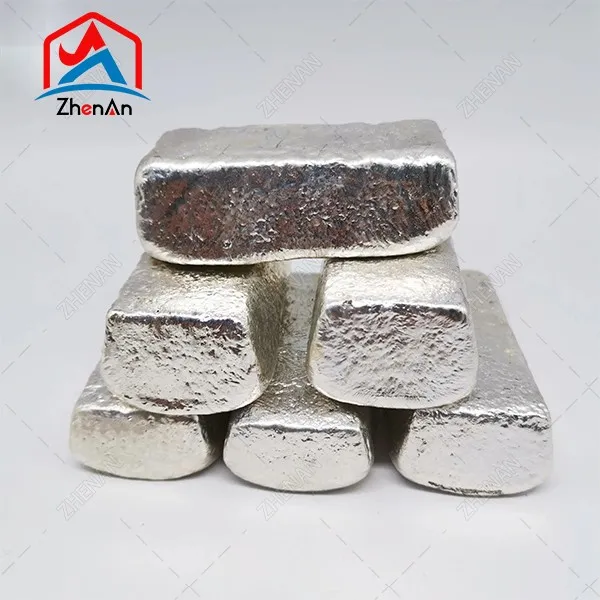
Common sizes: 7–8 kg/ingot, 300–1000 kg bundles
Surface: silver-white metallic
Packaging: steel strapped bundles / palletized
How to select the correct magnesium ingot grade?
The correct magnesium grade selection starts with understanding the end-use metallurgy requirement. In steelmaking applications, magnesium is primarily used for desulfurization and inclusion modification, so industrial grade magnesium (≥99.5%) is sufficient and cost-effective. The focus here is reactivity rather than ultra-high purity.
For aluminum alloy production, magnesium acts as an alloying element that improves strength, hardness, and corrosion resistance. In this case, high purity magnesium (≥99.9%) is preferred to ensure stable alloy composition and reduce impurity interference during melting.
In die casting applications, alloy grade magnesium is commonly used. These alloys often contain controlled additions of aluminum, zinc, or manganese to improve fluidity, casting performance, and mechanical strength. Selection here is based more on mechanical performance than purity alone.
For aerospace and precision industries, ultra-high purity magnesium is required because even trace impurities like Fe, Ni, and Cu can significantly affect corrosion resistance and fatigue performance.
Key industrial factors influencing magnesium grade selection
One of the most important factors is impurity control, especially Fe, Ni, and Cu. These elements can dramatically reduce corrosion resistance in magnesium alloys. Therefore, higher purity grades are always required for corrosion-sensitive applications.
Another factor is reaction behavior in molten metal. Lower-grade magnesium reacts more aggressively and is suitable for refining processes like desulfurization, while high-purity magnesium provides more controlled and predictable alloying behavior.
Cost is also a key consideration. Industrial buyers often balance performance vs. price, selecting the lowest grade that still meets metallurgical requirements.
Grade Comparison: Industrial Mg vs High Purity Mg vs Alloy Mg
Industrial Grade Mg vs High Purity Mg
Industrial grade magnesium is mainly used for steel desulfurization and general metallurgical refining, where extreme purity is not required. High purity magnesium is used in aluminum alloy production and precision metallurgy, where impurity control directly affects final alloy performance. The main difference lies in impurity tolerance and application sensitivity.
High Purity Mg vs Alloy Grade Mg
High purity magnesium focuses on chemical consistency and low impurity content, while alloy grade magnesium is intentionally modified with elements like aluminum and zinc to enhance mechanical strength and casting performance. High purity is used for controlled alloying, while alloy grade is designed for direct die casting applications.
Summary
Selecting the right magnesium ingot grade requires balancing purity level, application requirements, and cost efficiency. Industrial grade magnesium is ideal for steelmaking and desulfurization, high purity magnesium is suitable for aluminum alloy production, and alloy grade magnesium is optimized for die casting applications. Understanding impurity sensitivity and final performance requirements is the key to making the correct purchasing decision.
FAQ – Magnesium Ingot Grade Selection
1. What is the most commonly used magnesium ingot grade?
The most commonly used grade is industrial grade magnesium (≥99.5%), mainly for steelmaking and metallurgical applications.
2. How do impurities affect magnesium performance?
Impurities like Fe, Ni, and Cu significantly reduce corrosion resistance and can negatively impact alloy strength and durability.
3. Which magnesium grade is used in aluminum alloys?
High purity magnesium (≥99.9%) is typically used in aluminum alloy production to ensure stable composition and performance.
4. Can industrial grade magnesium be used for die casting?
It is not recommended. Die casting requires alloy grade magnesium with controlled additives for better fluidity and mechanical properties.
5. Why is ultra-high purity magnesium expensive?
Because it requires advanced refining processes to reduce trace impurities to extremely low levels, increasing production cost.
6. What is the main difference between alloy magnesium and pure magnesium?
Pure magnesium focuses on chemical purity, while alloy magnesium is engineered with additional elements to improve casting and mechanical performance.
Looking for Reliable Magnesium Ingot Supply?
We supply industrial grade, high purity, and alloy magnesium ingots with stable quality, consistent composition, and competitive factory pricing for global metallurgical and casting industries.
Contact us for quotation and technical support:
Email: sales@zanewmetal.com
WhatsApp: +86 15518824805
Stable Mg content & low impurity control
Bulk supply for steelmaking & casting industries
Fast global delivery support
Third-party inspection available
Why Choose ZhenAn
Trusted Magnesium Ingot Supplier – Purity · Stability · Global Supply
All magnesium ingots are produced under ISO9001-certified systems with strict control from raw magnesium refining to casting and packaging. COA, SDS, and REACH documents are available to support international trade requirements.
30+ Years of Metal Industry Experience
With decades of non-ferrous metal expertise, ZhenAn ensures stable magnesium quality suitable for die-casting alloys, steel desulfurization, and chemical applications.
Stable Purity & Clean Casting Quality
Strict control of Mg content and impurity elements (Fe, Ni, Cu) ensures consistent combustion behavior, stable melting performance, and reduced defect rates in downstream applications.
Reliable Supply & Flexible Specifications
Multiple ingot weights and packaging options are available. Strong production capacity ensures stable long-term supply for global customers and distributors.
Fast Response & Export Support
24-hour quotation service with professional logistics and documentation support, ensuring efficient and smooth international delivery.