


Summary of China's silicon carbide market as of April 10, 2026?
| Summary of China's Silicon Carbide Market as of April 10, 2026 | |||
| Unit: Yuan/ton, cash price including tax | |||
| Introduction: The prices below are for reference only. Manufacturers can set prices according to their own actual situation. | |||
| product | Grade (block material) | Today's price | Note (Northwest Region) |
| silicon carbide | 98 | 5800-5900 | -- |
| 88 | 4800-4900 | -- | |
| 1) 98# silicon carbide | |||
| area | Today's price | rise and fall | |
| Gansu | 5800-5900 | -- | |
| Ningxia | 5800-5900 | -- | |
| 2) 88# Silicon Carbide | |||
| area | Today's price | rise and fall | |
| Gansu | 4800-4900 | -- | |
| Ningxia | 4800-4900 | -- | |
What is Silicon Carbide Used For?
Silicon carbide (SiC, 85% and below grades) is a high-performance industrial material widely used as a refractory additive, abrasive material, metallurgical deoxidizer, and functional filler in steelmaking, casting, and industrial processing. In grades such as 85%, 80%, 75%, and 70%, silicon carbide is mainly applied in metallurgy and foundry industries to improve melting efficiency, reduce impurities, increase furnace temperature, and enhance the quality of steel and cast iron.
Silicon Carbide (≤85%) Specifications
| Grade | SiC Content (%) | Free Si (%) | Free C (%) | Fe2O3 (%) | Moisture (%) | Size Range | Main Application |
|---|---|---|---|---|---|---|---|
| SiC 85 | ≥85 | ≤2.0 | ≤3.0 | ≤1.5 | ≤0.5 | 0–1 mm / 1–10 mm | High-grade steelmaking |
| SiC 80 | ≥80 | ≤3.0 | ≤4.0 | ≤2.0 | ≤0.5 | 0–3 mm / 1–5 mm | Foundry & casting |
| SiC 75 | ≥75 | ≤4.0 | ≤5.0 | ≤2.5 | ≤0.5 | 0–5 mm | General metallurgy |
| SiC 70 | ≥70 | ≤5.0 | ≤6.0 | ≤3.0 | ≤0.5 | 0–10 mm | Low-cost steel refining |
Packaging: 1 MT jumbo bag / 25 kg bags
Form: Lump / granule / powder
What is silicon carbide used for in steelmaking?
Silicon carbide is widely used in steelmaking as a cost-effective deoxidizer and carbon-silicon alloying material. During steel refining, SiC reacts with oxygen in molten steel, producing silicon oxide and carbon monoxide, which helps remove oxygen and reduce impurities.
Compared with traditional ferrosilicon and carbon additives, silicon carbide provides a dual effect of silicon and carbon supply, which improves deoxidation efficiency and enhances steel strength at the same time. This makes it especially suitable for medium and low-grade steel production, rebar steel, and structural steel casting.
What is silicon carbide used for in casting and foundry?
In foundry applications, silicon carbide is used to improve melting efficiency and microstructure control of cast iron. It helps increase furnace temperature, reduce melting time, and improve carbon distribution in molten iron.
In gray iron and ductile iron production, SiC promotes stable graphite formation, reducing shrinkage defects and improving mechanical properties. Lower-grade SiC (70–80%) is commonly used in cost-sensitive casting processes, while higher-grade SiC (85%) is used for better control of composition and cleaner melt conditions.
Industrial applications of silicon carbide (≤85%)
Silicon carbide is also used in a wide range of metallurgical and industrial processes beyond steel and casting.
In ladle refining, SiC acts as a deoxidizer and carburizer, improving steel cleanliness. In refractory materials, it enhances thermal shock resistance and high-temperature strength of furnace linings. It is also used in abrasive and grinding applications, where its hardness makes it ideal for surface treatment and polishing of metals and ceramics.
Because of its stability and cost efficiency, silicon carbide has become a key consumable in large-scale steel plants and foundries focusing on production efficiency and cost control.
Grade Comparison: SiC 85 vs SiC 80 vs SiC 75
SiC 85 vs SiC 80
SiC 85 has higher silicon carbide content and provides stronger deoxidation performance and cleaner steel quality, making it suitable for higher-grade steel production. SiC 80 is slightly lower in purity but offers better cost efficiency, making it widely used in general foundry and medium-grade steelmaking.
SiC 85 vs SiC 75
SiC 85 is used in applications requiring higher control of impurities and better metallurgical stability, while SiC 75 is more suitable for basic steel refining and cost-sensitive casting operations. The main difference lies in deoxidation efficiency and final steel cleanliness level.
Summary
Silicon carbide (≤85% grades) is a multifunctional metallurgical material used mainly in steelmaking, casting, and refractory industries. It serves as a deoxidizer, carburizer, and thermal enhancer, improving steel quality while reducing production cost. Different grades such as 85%, 80%, 75%, and 70% are selected based on required purity, cost balance, and application intensity.
FAQ – Silicon Carbide (≤85%) Applications
1. What is silicon carbide used for in steelmaking?
It is used as a deoxidizer and carbon-silicon additive, improving steel purity and reducing oxygen content.
2. Why is SiC used instead of ferrosilicon?
SiC provides both carbon and silicon, offering better cost efficiency and dual metallurgical effects.
3. What is the difference between SiC 85 and SiC 70?
SiC 85 has higher purity and stronger deoxidation ability, while SiC 70 is used for low-cost, general applications.
4. Can silicon carbide improve casting quality?
Yes, it improves graphite formation, reduces shrinkage defects, and enhances cast iron strength.
5. What industries use silicon carbide 80%?
It is widely used in foundries, steel plants, and general metallurgy industries.
6. Is silicon carbide used in refractories?
Yes, it improves thermal resistance and strength of furnace linings and refractory materials.
Looking for Stable Silicon Carbide Supply?
We supply SiC 85%, 80%, 75%, and 70% with stable quality, controlled impurity levels, and competitive factory pricing for global steelmaking and foundry industries.
Contact us for quotation and bulk supply:
Email: sales@zanewmetal.com
WhatsApp: +86 15518824805
Stable SiC content & consistent quality
Bulk supply for steel & casting industries
Fast global delivery support
Third-party inspection available
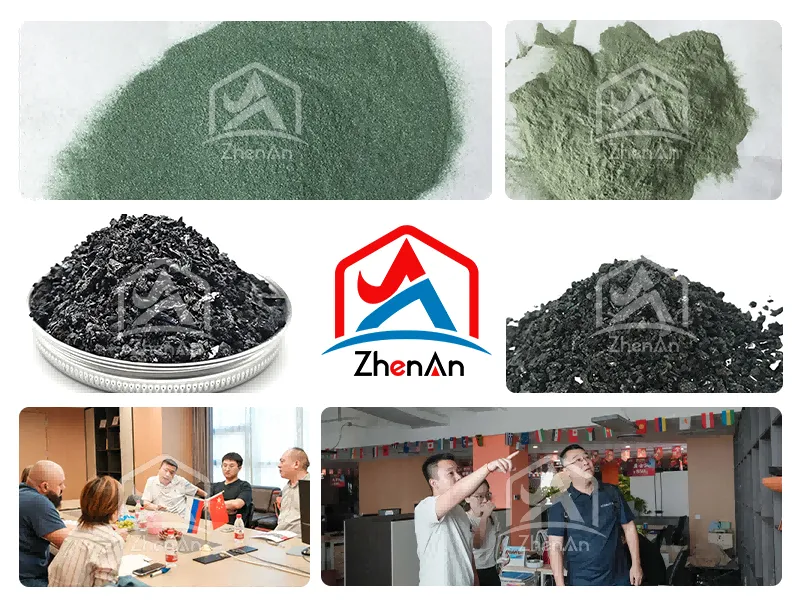
Why Choose ZhenAn
Reliable Silicon Carbide Supplier – Grade Control · Cost Efficiency · Stable Supply
All silicon carbide products (≤85% SiC grades) are manufactured under ISO9001-certified systems with strict control of carbonization, crushing, and screening processes. COA, SDS, and REACH documents are available to support global industrial procurement.
30+ Years of Industrial Material Experience
With decades of expertise in non-metallic minerals and metallurgical raw materials, ZhenAn provides stable and cost-effective silicon carbide solutions tailored for large-scale industrial applications.
Accurate Grade Control for 85% Below SiC
Specialized in SiC 85%, 80%, 75%, and 70% grades, with stable carbon and silicon balance control to ensure consistent performance in abrasives, metallurgy, and refractory applications.
Stable Supply & Flexible Particle Sizes
Strong production capacity ensures continuous bulk supply. Multiple particle sizes and packaging options are available to meet different furnace, casting, and grinding requirements.
Fast Response & Export Service
24-hour quotation support with full export documentation and logistics coordination, ensuring smooth delivery to global customers and distributors.