


Silicon Metal Applications: Where Does Metallurgical Silicon Go?
Silicon metal is the raw material backbone of four major industrial supply chains: aluminum casting, silicone chemistry, photovoltaic manufacturing, and semiconductor fabrication. Depending on purity, a single ton of metallurgical-grade silicon can end up as engine blocks, medical sealants, solar panels, or the wafers inside your phone. This page maps each downstream use to the grade, particle size, and impurity limits that actually matter on the factory floor.
🏭 What Is Silicon Metal Used For?
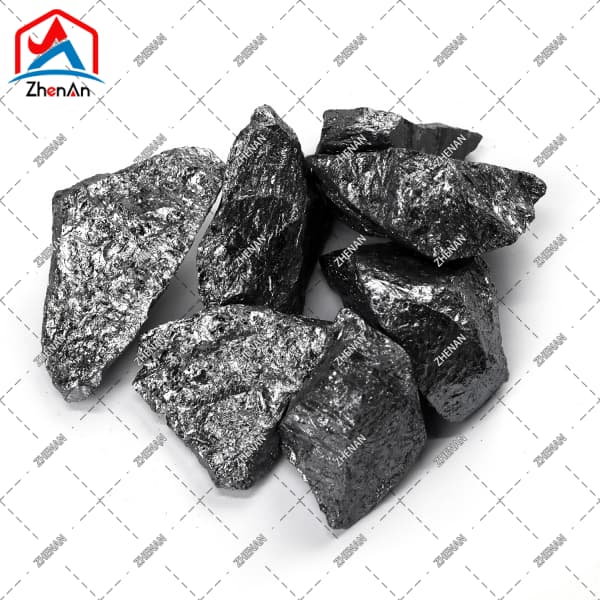
At its core, silicon metal is elemental silicon (Si) produced by smelting quartz and carbon reductants in submerged-arc furnaces at temperatures above 2,300 °C. Purity ranges from roughly 98.5 % Si in metallurgical grades to 99.5 % and above in chemical and solar grades. The deciding factor for which grade goes where is not just silicon content - it is the controlled limit on iron, aluminum, and calcium, which can wreck alloy strength, poison chemical reactions, or add defects to crystal growth.
Global silicon metal output sits around 3 million metric tons per year, with roughly 60–70 % originating from China. The material splits into four consumption streams: aluminum alloys (35–40 %), silicone polymers and chemicals (~28 %), solar polysilicon (~18 %), and smaller but high-value segments like semiconductors, ferrosilicon, and ceramics.
🚗 Aluminum Alloys & Automotive Casting
Silicon metal applications in aluminum casting start with a simple fact: adding 6–12 % silicon by weight to aluminum dramatically improves fluidity, reduces shrinkage cracking, and raises wear resistance. That is why A356 (7 % Si) dominates aerospace structural castings, and A380 (8.5 % Si) is the workhorse alloy for automotive die-casting.
The automotive sector alone accounts for the largest slice of silicon metal demand. Engine blocks, transmission housings, suspension brackets, and - increasingly - electric vehicle battery enclosures all rely on aluminum-silicon alloys. Hypereutectic Al-Si grades with 17–22 % Si are pressed into cylinder liners and pistons where hardness and thermal stability matter more than ductility.
Procurement teams usually specify 441 or 553 grade silicon metal for these applications. Grade 441 (Si ≥ 99.0 %, Fe ≤ 0.4 %, Al ≤ 0.4 %, Ca ≤ 0.1 %) delivers the purity needed for consistent casting performance without the cost premium of higher grades. Grade 553 (Si ≥ 98.5 %) works fine for less critical structural parts where cost efficiency outweighs tight impurity control.
Why Does Ca Content Matter in Alloy-Grade Silicon?
Calcium above 0.1 % can form hard intermetallic inclusions that machine poorly and create porosity in thin-wall castings. That is why foundries buying for high-pressure die-casting often cap calcium at 0.03 % or lower, pushing them toward 3303-grade feedstock even though the silicon purity gain itself is modest.
🧪 Silicone Polymers & Chemical Synthesis
The second-largest destination for silicon metal applications is the silicone industry. In the Rochow-Müller direct process, silicon metal reacts with methyl chloride (CH₃Cl) in a fluidized-bed reactor to produce dimethyldichlorosilane - the precursor for polydimethylsiloxane (PDMS) and the entire silicone polymer family.
This reaction is finicky. Iron, aluminum, and calcium interfere with catalyst selectivity and reaction yield. Chemical-grade silicon metal therefore demands tighter impurity control than metallurgical grades: typically 3303 (Si ≥ 99.3 %, Fe/Al ≤ 0.3 %, Ca ≤ 0.03 %) or 2202 (Si ≥ 99.5 %, Fe/Al ≤ 0.2 %, Ca ≤ 0.02 %). Off-spec metal means off-spec silane distribution, which translates directly to off-spec sealants, rubbers, or coatings downstream.
The global silicone market was valued at approximately $18.4 billion in 2025 and is projected to reach $28.6 billion by 2034. Applications run from construction sealants and automotive gaskets to medical implant coatings and food-processing equipment. Each of these segments traces back to a few hundred kilograms of high-purity silicon metal sitting in a reactor somewhere.
☀️ Polysilicon, Solar Cells & Photovoltaics
Solar-grade polysilicon production is the fastest-growing demand segment for silicon metal applications, expanding at roughly 8–10 % annually. Silicon solar cells represent about 95 % of global photovoltaic capacity, which crossed 1.6 terawatts of installed capacity in 2024. Monocrystalline PERC cells now dominate commercial production at 22–24 % efficiency, with newer TOPCon architectures pushing toward 25 %.
Producing solar-grade polysilicon starts with metallurgical-grade silicon metal and refines it through the Siemens chemical vapor deposition process or fluidized-bed reactor routes. The feedstock must carry Si purity of 99.9 % or higher, with extremely tight control on boron and phosphorus - impurities that degrade minority-carrier lifetime and cell efficiency. Grade 2202 or better is typically the starting point, though many polysilicon producers enforce custom specifications that go beyond standard industrial grades.
China accounts for over 80 % of global polysilicon capacity, but new investments in India, Southeast Asia, North America, and Europe are gradually diversifying the supply map. For procurement teams, this means origin documentation and batch traceability are becoming standard requirements, not nice-to-haves.
💻 Semiconductor Wafers & Electronics
At the top of the purity pyramid, semiconductor manufacturing demands silicon metal that has been refined to 99.9999999 % purity - nine nines, or 9N. This material does not ship as "silicon metal" in the commodity sense; it is converted through chlorosilane distillation, Czochralski (CZ) or float-zone (FZ) crystal growth, and precision wafering into 150–300 mm substrates.
Still, the supply chain begins with high-purity metallurgical silicon. Electronic-grade silicon metal (typically 2202 or custom spec) is the first purification feedstock. Trace impurities at the part-per-billion level - aluminum, iron, carbon, oxygen - can shift transistor threshold voltages and kill yield at advanced process nodes. That is why semiconductor fabs audit their silicon suppliers down to the mine and smelter level.
Beyond logic and memory chips, high-purity silicon finds use in MEMS sensors, Si photonics for data-center interconnects, and infrared optics where silicon's transparency from 1.1–7 µm is exploited for thermal-imaging windows and LiDAR lenses.
⚙️ Steel Deoxidation, Ferrosilicon & Other Uses
Not every kilogram of silicon metal ends up in a high-tech application. A significant share - roughly 45 % of all metallurgical silicon production - is consumed in ferrosilicon (FeSi) manufacturing, where silicon content ranges from 15 % to 90 %. Ferrosilicon is the primary deoxidizer in steelmaking and an inoculant in cast iron to promote graphite nucleation.
Other industrial uses include silicon carbide (SiC) production for abrasives and high-power electronics substrates, silicon nitride (Si₃N₄) ceramics for cutting tools and turbine components, and specialty alloys. These applications typically accept 553-grade or lower-purity material, making them the price-floor segment of the silicon metal market.
❓ Frequently Asked Questions About Silicon Metal Applications
Which grade of silicon metal is best for aluminum casting?
Grade 441 is the most common choice for aluminum alloy production because it balances purity and cost. Foundries producing thin-wall or high-pressure die-cast parts often specify 3303 to keep calcium below 0.03 % and avoid inclusion defects.
Can 553-grade silicon metal be used for silicone production?
Generally no. The iron, aluminum, and calcium levels in 553 are too high for the Rochow-Müller direct process. Silicone manufacturers typically require 3303 or 2202 grade to maintain reaction selectivity and product consistency.
What purity does solar-grade polysilicon start from?
Solar-grade polysilicon refining begins with metallurgical silicon of at least 99.5 % purity, usually 2202 grade or custom chemical-grade feedstock. The Siemens CVD or fluidized-bed process then purifies it to 99.9999 % (6N) or higher.
Is silicon metal the same as ferrosilicon?
No. Silicon metal is elemental silicon (98.5–99.5 %+ Si). Ferrosilicon is an iron-silicon alloy containing 15–90 % Si. Ferrosilicon is produced from silicon metal or directly from quartz and iron sources in submerged-arc furnaces.
Which silicon metal grade is used for semiconductor wafers?
Semiconductor wafer production starts from electronic-grade silicon refined to 9N purity (99.9999999 %). The initial metallurgical feedstock is typically ultra-high-purity 2202 or custom-spec material, but the bulk of purification happens in dedicated chlorosilane and crystal-growth facilities.
How fast is demand growing for solar-grade silicon metal?
Solar-grade silicon metal demand is expanding at roughly 8–10 % annually, driven by global PV installations projected to exceed 400 GW per year by the early 2030s. This makes solar the fastest-growing end-use segment for silicon metal.
📞 Contact Us
Need help matching the right silicon metal grade to your application? Whether you are specifying alloy additions, chlorosilane feedstock, or polysilicon precursor material, we can advise on grade selection, particle size, and impurity limits that fit your process.
Get in touch for a quotation, Certificate of Analysis sample, or technical discussion.
Hot Tags: silicon metal applications: where does metallurgical silicon go?, China silicon metal applications: where does metallurgical silicon go? manufacturers, suppliers