


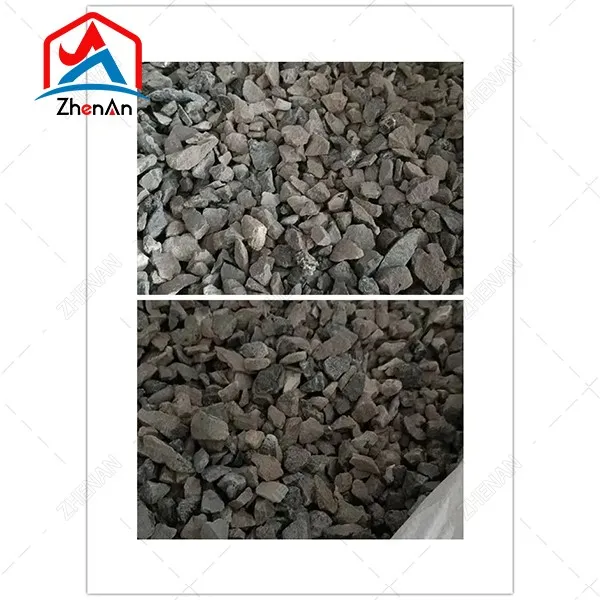
Why Calcium Carbide Particle Size Control Matters in Turkish EAF Steelmaking
In Turkish Electric Arc Furnace (EAF) steelmaking, Calcium Carbide (CaC₂) is widely used as a primary desulfurization agent during ladle refining. However, when particle size distribution is uneven-containing both oversized lumps and excessive fines-it directly disrupts reaction uniformity in molten steel.
Desulfurization using Calcium Carbide depends on controlled solid–liquid reaction kinetics within slag-metal interaction zones. Uneven sizing leads to inconsistent dissolution rates, unstable calcium activity release, and irregular sulfur removal efficiency across heats. As a result, sulfur levels in steel batches become difficult to control within tight tolerances required for structural and high-grade steel production.
👉 ZhenAn supplies controlled-size Calcium Carbide optimized for stable desulfurization performance in EAF ladle metallurgy systems.
📩 Email: sales@zanewmetal.com | WhatsApp: +86 15518824805
How Uneven Calcium Carbide Particle Size Affects Desulfurization Efficiency
Desulfurization in EAF ladle refining is governed by the reaction:
CaC₂ + S → CaS + C
For this reaction to proceed efficiently, Calcium Carbide must dissolve and release active calcium species at a predictable rate. When particle size is uneven, the reaction becomes non-uniform.
Oversized particles dissolve slowly, delaying calcium availability and reducing early-stage desulfurization efficiency. At the same time, fine particles react too rapidly, creating localized high-reactivity zones that deplete calcium activity before full slag-metal equilibrium is achieved.
This imbalance leads to fluctuating sulfur removal rates during the same heat, making final sulfur control less stable and increasing rework risk in high-grade steel production.
Why Particle Size Distribution Is Critical in Turkish EAF Operations
Turkish steel plants operate a mix of export-oriented long product and construction steel production, where sulfur consistency directly affects mechanical properties and weldability.
In these operations, Calcium Carbide is typically injected or added into ladles during secondary metallurgy. If particle sizing is inconsistent, operators observe:
Irregular slag foaming behavior
Unstable desulfurization kinetics between heats
Increased variation in final sulfur levels
Higher dependency on corrective additives
Because modern Turkish EAF facilities often run high-throughput production schedules, even small inconsistencies in desulfurization behavior can lead to significant downstream quality variation.
👉 ZhenAn provides size-classified Calcium Carbide designed for consistent slag reaction behavior and stable sulfur control.
📩 Contact: sales@zanewmetal.com | WhatsApp: +86 15518824805
Technical Specifications of Size-Controlled Calcium Carbide for EAF Desulfurization
| Item | Specification |
|---|---|
| Chemical Formula | CaC₂ |
| CaC₂ Content | 70% – 80% |
| Particle Size Range | 10–80mm (controlled grading) |
| Fines Content (<5mm) | ≤ 5% |
| Reaction Function | Desulfurization in ladle refining |
| Gas Yield | 280–300 L/kg |
| Moisture Content | ≤ 1.5% |
| Application | EAF / LF steelmaking |
ZhenAn applies mechanical screening and grading separation to ensure consistent particle distribution suitable for injection and manual addition systems.
Where Calcium Carbide Size Consistency Matters in EAF Steelmaking
In Turkish EAF operations, Calcium Carbide is primarily used during ladle metallurgy after primary steelmaking in the furnace. At this stage, sulfur removal is critical to achieving final steel grade specifications.
When particle size is controlled, Calcium Carbide dissolves uniformly in slag, ensuring stable calcium release and predictable sulfur absorption into CaS compounds.
However, when sizing is inconsistent, reaction zones become uneven. Some parts of the ladle experience rapid desulfurization, while others remain under-reacted. This leads to non-uniform sulfur distribution and increases the likelihood of off-spec heats.
Controlled sizing also improves slag fluidity and enhances mixing efficiency under argon stirring conditions commonly used in Turkish EAF plants.
Uneven Sizing vs Controlled Sizing
In procurement decisions, steel plants often compare standard unsorted Calcium Carbide with size-classified grades.
Standard material may include a wide particle distribution, which introduces variability in reaction speed and desulfurization performance. Controlled sizing reduces this variability and improves process predictability.
| Parameter | Controlled Sizing CaC₂ | Uneven Sizing CaC₂ |
|---|---|---|
| Reaction Uniformity | High | Low |
| Sulfur Control Stability | Stable | Fluctuating |
| Slag Reaction Behavior | Predictable | Irregular |
| Heat-to-Heat Consistency | Strong | Weak |
| Process Adjustment Needs | Low | High |
Product Delivery, Packaging, and Logistics
Calcium Carbide is highly sensitive to moisture and mechanical degradation, making packaging and particle integrity critical for maintaining performance during transport to Turkey.
ZhenAn supplies Calcium Carbide in sealed steel drums or reinforced iron drums with internal protective liners to preserve both moisture resistance and particle size integrity.
Standard packaging includes 50kg and 100kg drums suitable for industrial ladle metallurgy systems. Bulk packaging options are available for large EAF steel plants.
All shipments include COA, MSDS, and particle size distribution reports. Dry container shipping with humidity control measures is used to maintain product stability during long-distance logistics.
FAQ
Q1: How does uneven calcium carbide particle size affect desulfurization efficiency?
It causes inconsistent reaction rates, leading to unstable sulfur removal across heats.
Q2: Why is calcium carbide sizing important in Turkish EAF steelmaking?
Because sulfur control must be consistent for export-grade steel production.
Q3: Can oversized calcium carbide reduce sulfur removal performance?
Yes, it delays calcium release and reduces reaction efficiency.
Q4: How do calcium carbide fines affect slag reaction efficiency?
They react too quickly, causing localized depletion of active calcium.
Q5: What particle size is preferred for steel desulfurization applications?
Typically 10–80mm controlled lump size with low fines content.
Q6: How does calcium carbide consistency influence molten steel sulfur control?
It ensures stable calcium availability and predictable desulfurization kinetics.
Q7: Can unstable carbide sizing increase steelmaking process fluctuation?
Yes, it leads to inconsistent heat-to-heat sulfur results.
Q8: Why do steel plants require controlled calcium carbide size distribution?
To maintain uniform reaction behavior and stable steel quality.
Why Turkish Steel Plants Choose ZhenAn Calcium Carbide
ZhenAn focuses on producing size-controlled Calcium Carbide tailored for EAF desulfurization systems. Our grading process ensures uniform particle distribution, stable reaction kinetics, and consistent sulfur removal performance across production batches.
We help steel plants improve heat stability, reduce desulfurization variability, and achieve more predictable steel quality outcomes.
📩 Email: sales@zanewmetal.com
📱 WhatsApp: +86 15518824805
Talk to Our Metallurgical Supply Team
If your EAF operations are experiencing inconsistent sulfur levels or slag reaction instability due to carbide sizing issues, ZhenAn can provide optimized particle-grade Calcium Carbide solutions tailored for Turkish steelmaking conditions.
👉 Send inquiry: sales@zanewmetal.com
👉 WhatsApp: +86 15518824805
Visit https://www.ferro-vanadium.com/to learn more about the product. If you would like to learn more about the product price or are interested in purchasing, please email sales@zanewmetal.com. We will get back to you as soon as we see your message.